
October 10, 2026
Your HVAC Technicians Are Ready for the Next Job. Is Your Website Bringing It In?
You have skilled technicians, reliable equipment, and a business built around solving problems. But when a potential customer needs heating or cooling service, does your website make it easy for them to choose you?
Picture a homeowner on a hot summer afternoon.
The air conditioner has stopped cooling. The temperature inside the house keeps climbing. They’ve checked the thermostat, tried switching the system off and on, and finally accepted that this isn’t something they can fix themselves.
They reach for their phone.
A quick search for “AC repair near me” brings up several heating and cooling companies.
One website takes too long to load. Another looks decent, but the phone number is buried in the footer. A third asks the homeowner to fill out a lengthy contact form without explaining when anyone will respond.
Then they find a local HVAC company with a straightforward website.
The company clearly explains its air conditioning repair services, lists the areas it serves, displays a phone number at the top of the page, and provides a simple way to request an appointment.
Which company is more likely to receive that inquiry?
Not necessarily the one with the most experienced technicians. Not necessarily the one offering the lowest price.
Often, it’s the company that makes the next step easiest.
This is something HVAC business owners should think about more often.
You can have excellent technicians, well-maintained service vehicles, and years of experience in heating and cooling. But if your website makes it difficult for customers to reach you, some of those opportunities may go elsewhere.
Your HVAC website should do more than prove your company exists. It should help turn people looking for service into actual customer inquiries.
And that requires more thought than simply choosing an attractive website template.
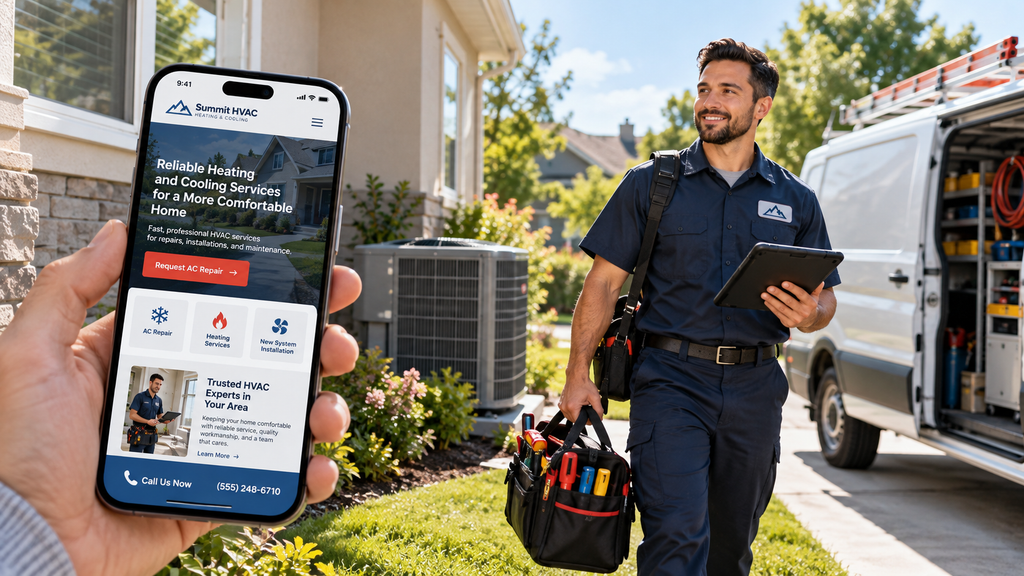
1. Your HVAC Business Doesn’t Stop Working When Your Office Closes. Neither Should Your Website.
HVAC problems don’t follow normal business hours.
An air conditioning unit can fail late on a Friday evening. A heating system might stop working during a cold weekend. A restaurant could discover a cooling problem shortly before opening.
When these situations happen, customers often begin looking for help online.
Your office may be closed, but your website is still available.
That makes it an important part of how potential customers discover your business.
A properly developed HVAC contractor website can explain what services you provide, identify your coverage area, and give visitors a way to contact you even when nobody is immediately available to answer the phone.
For businesses offering emergency HVAC repairs, the website should make those services easy to identify.
For companies operating during regular business hours, it should communicate availability clearly rather than promising immediate assistance that isn’t actually offered.
This distinction matters.
A customer with a broken air conditioner doesn’t want to spend several minutes trying to determine whether your company handles emergency repairs or only scheduled installations.
They want answers.
A useful HVAC website should quickly communicate:
- What heating and cooling services your company provides.
- Which cities, towns, or neighborhoods you serve.
- How customers can contact you or request service.
- Whether emergency or after-hours service is available.
- What happens after a customer submits an inquiry.
These details may sound simple.
But simplicity is exactly what customers need when they’re dealing with an uncomfortable or urgent situation.
2. Your Website May Be Losing HVAC Leads Without You Realizing It
Most business owners notice when the phone rings.
It’s harder to notice when someone visits your website and leaves without contacting you.
There’s no missed-call notification. No message explaining why they chose another contractor.
The visitor simply disappears.
Perhaps your website appeared in a local search result, but the page took too long to load.
Maybe the visitor wanted a furnace repair, but your homepage mostly talked about air conditioning installation.
Perhaps they couldn’t tell whether you served their location.
Or maybe your contact form was difficult to complete on a mobile phone.
Each of these situations creates friction between a potential customer and your business.
That doesn’t mean every visitor would have become a paying customer. Some are comparing prices, researching future installations, or simply gathering information.
But when someone is ready to request service, unnecessary obstacles can make a difference.
Common HVAC website problems worth checking
A phone number that’s difficult to find
On mobile devices, customers should be able to identify your primary contact option quickly. A clearly labeled tap-to-call button is especially useful for urgent repair inquiries.
Service pages that don’t answer basic questions
A generic page saying “We provide quality HVAC services” doesn’t explain whether you repair ductless mini-splits, replace heat pumps, or maintain commercial air conditioning systems.
Unclear service areas
If customers can’t determine whether you serve their location, they may contact another company rather than ask.
Contact forms with too many unnecessary fields
A homeowner requesting an AC repair shouldn’t have to complete a form that feels like a commercial equipment inspection report.
Poor mobile usability
Small buttons, difficult navigation, intrusive popups, and layouts that don’t fit the screen can make a website frustrating to use.
Outdated information
Old phone numbers, incorrect opening hours, unavailable services, and broken links can damage confidence before a conversation even begins.
These issues aren’t always obvious when you look at your website from a desktop computer.
Try visiting it on your phone as though you’ve never heard of your company before.
Can you find the service you need?
Can you confirm the company serves your area?
Can you request help without searching through several pages?
If the answers aren’t clear, your website may need more than a visual refresh.
It may need a better customer journey.
3. HVAC Customers Aren’t All Looking for the Same Thing
Consider three people visiting your website.
The first is a homeowner whose air conditioner has stopped working.
The second is planning to replace an aging heating system before winter.
The third manages a commercial building and needs a contractor for ongoing HVAC maintenance.
All three need HVAC services.
But their priorities are different.
The homeowner wants help quickly.
The person planning a replacement may want information about installation options, equipment suitability, financing availability, and the process of requesting an estimate.
The commercial property manager may be interested in preventive maintenance schedules, service agreements, documentation, and the types of equipment your technicians support.
A single generic services page may struggle to serve all three audiences well.
This is why HVAC website design should begin with understanding the customers you want to attract.
Emergency HVAC repair customers
These visitors often need immediate clarity.
A useful emergency repair page should emphasize your actual availability, service coverage, supported equipment, and the fastest way to contact your company.
If you offer 24-hour emergency HVAC service, explain how customers can reach your team outside regular business hours.
If you don’t offer emergency service, avoid creating that expectation.
HVAC installation customers
Installation projects usually involve more consideration.
Customers may be comparing companies, reviewing equipment options, and deciding whether to repair or replace an existing system.
Your website can support that process with dedicated installation pages, explanations of your assessment process, completed project examples, and a straightforward quote request.
Commercial HVAC customers
Commercial clients may need more detailed information.
They may want to know which equipment types you service, whether you support scheduled maintenance, how service requests are handled, and what kinds of properties you work with.
A dedicated commercial HVAC services section can help communicate these capabilities without forcing commercial customers to search through residential content.
The important point is that different customer needs deserve different paths through your website.
A custom HVAC website can be structured around those paths rather than relying entirely on a generic contractor template.
4. A Professional HVAC Website Should Be Built Around Service Inquiries
Let’s talk about something more useful than simply making a website look modern.
What should happen when a potential customer arrives?
Imagine someone searching for air conditioning repair in your service area.
They land on a page specifically about AC repair.
The heading confirms that they’re in the right place. The page explains the types of cooling problems your company handles. It identifies the service area and offers a clear way to request assistance.
The visitor doesn’t need to return to the homepage.
They don’t need to browse a long list of unrelated services.
They can take the next step directly.
This is an example of designing a website around a customer action.
For an HVAC business, those actions might include requesting a repair appointment, calling the office, asking for an installation estimate, or inquiring about a maintenance agreement.
What makes an effective HVAC service page?
A useful service page generally includes a clear description of the service, the types of problems or equipment covered, relevant service locations, trust-building information, and an appropriate call to action.
For example, an air conditioning repair page might address common issues such as:
- An AC system running but not cooling properly.
- Unusual noises or odors from the equipment.
- Frequent cycling or unexpected shutdowns.
- Water leaking around an indoor unit.
- Thermostat or airflow problems.
- Inconsistent temperatures between rooms.
The page should avoid pretending that every symptom has one simple cause.
Its purpose is to help customers recognize that your company handles the type of problem they’re experiencing and explain how to request a professional assessment.
Good HVAC website development makes it easier for the right customer to reach the right service.
That’s a more useful objective than filling every page with large buttons and generic sales slogans.
5. Your Service Area Deserves More Than a List of City Names
Local visibility matters for HVAC contractors.
Most homeowners aren’t looking for a technician several hours away. They want a company that serves their neighborhood and can realistically reach their property.
That’s why location information is an important part of both the customer experience and local HVAC SEO.
Suppose your heating and cooling business serves several nearby cities.
A visitor should be able to determine whether their address falls within your coverage area.
You might include a dedicated service-area page, a clear list of locations, and relevant information on individual service pages.
For larger coverage areas, it may make sense to create separate location pages.
However, those pages need to offer genuine value.
Creating fifty nearly identical pages and changing only the city name is not a strong long-term content strategy.
A useful HVAC service-area page might explain which services are available in that location, whether response times or scheduling differ, and what customers should know before booking.
Where appropriate, it could include genuine local project examples, customer feedback, or information about the equipment commonly serviced in that area.
Local SEO begins with accurate business information
Your website should also use consistent company details.
Your business name, phone number, address where appropriate, operating hours, and service coverage should match the information customers see on your Google Business Profile and other legitimate business listings.
Relevant structured data can help search engines interpret business information, although it doesn’t guarantee enhanced search appearances or rankings.
Location pages should also have descriptive titles, useful headings, and content that genuinely helps local customers.
For example, a page titled “Air Conditioning Repair in [City]” should actually explain your air conditioning repair services in that city.
It shouldn’t exist only to repeat a search phrase.
A properly planned HVAC WordPress website can support this structure while making it easier to maintain service and location information as your business expands.
6. Your Technicians Need Good Job Information, Not Just More Contact Forms
Generating inquiries is only part of the process.
The quality of information your office receives can affect how efficiently your team responds.
Imagine receiving this message:
“My AC isn’t working. Please call me.”
You have a potential customer, but you still need to ask several questions.
Where is the property?
What type of system is involved?
Is the equipment completely nonfunctional or simply not cooling?
When did the issue begin?
Is the customer requesting urgent service or a future appointment?
Now imagine an HVAC service request form that gathers the essential details without becoming difficult to complete.
It could ask for the customer’s name, phone number, service address, type of service needed, a short description of the issue, and preferred contact time.
Additional fields could appear only when relevant.
For instance, someone requesting a new installation estimate might be asked different questions from someone reporting an emergency breakdown.
This is where a custom HVAC service request form built with WordPress can be useful.
A better form can support a better workflow
Instead of collecting the same generic information from every visitor, a custom form can adapt to the type of inquiry.
A repair request might collect basic symptoms and the equipment type.
An installation inquiry might ask about the property and whether an existing system needs replacement.
A commercial maintenance inquiry might request the facility type, approximate equipment count, and preferred service arrangement.
The submitted information can then be organized for the office team.
Depending on the business’s needs, the website could send notifications, create a reference number, or integrate with a scheduling or customer management system.
These features need to be planned carefully.
The website should collect only necessary information, protect submitted data, and avoid promising appointment availability unless it’s connected to a reliable scheduling process.
A form submission also shouldn’t automatically be treated as a confirmed service appointment unless the company has explicitly designed its workflow that way.
The goal is straightforward: reduce unnecessary back-and-forth while making it easier for customers to request help.
7. Your HVAC Website Should Work Properly on a Phone
Think about where customers might be when they search for HVAC services.
Some are sitting at home.
Others are at work, managing a property, or standing beside equipment that has just stopped functioning.
Many will be using a smartphone.
That means mobile usability isn’t an optional extra.
It’s a central part of effective HVAC contractor website design.
A responsive website should adapt to smaller screens without requiring visitors to zoom, scroll sideways, or struggle with tiny controls.
But responsive design alone isn’t enough.
A page can technically fit a phone screen and still be difficult to use.
Mobile-first HVAC website features worth considering
A visible contact option
A tap-to-call button can make contacting your business more convenient, especially for urgent inquiries.
Simple navigation
Customers should be able to reach repair, installation, maintenance, and contact information without navigating through several complicated menus.
Readable content
Headings, paragraphs, and buttons should be easy to read and interact with.
Fast-loading images
Large photographs can look impressive, but they should be appropriately sized and optimized for different devices.
Forms designed for touchscreens
Fields should be easy to select, labels should be clear, and users shouldn’t have to enter unnecessary information.
No disruptive visual effects
Animations and decorative elements shouldn’t interfere with reading or contacting your company.
Website performance also deserves attention.
Image optimization, appropriate caching, efficient code, and careful use of third-party scripts can all contribute to a better experience.
Google’s Core Web Vitals provide useful measurements of loading performance, responsiveness, and visual stability.
They aren’t the only indicators of website quality, but they can help identify technical issues worth improving.
For HVAC companies, the practical objective is simple.
When a customer needs service, the website should make contacting you easy—not give them another problem to solve.
8. Trust Matters Before a Customer Lets a Technician Into Their Home
Hiring an HVAC contractor involves more than choosing someone who can repair equipment.
Customers may be inviting technicians into their homes, trusting them with expensive systems, or committing to substantial installation costs.
They want reasons to feel confident about the company they’re contacting.
Your website can help provide those reasons.
Not through exaggerated claims, but through specific, verifiable information.
Show the people behind the business
Real photographs of your technicians, service vehicles, workshop, or completed installations can make your company feel more tangible.
Generic stock photographs may help fill a design, but they don’t show customers who will actually perform the work.
Explain your experience accurately
If your company has operated for fifteen years, say so.
If your technicians hold relevant licenses or certifications, explain them accurately and keep the information current.
If you’re an authorized installer or service partner for particular equipment brands, mention that only when the relationship is genuine.
Publish authentic customer reviews
Customer feedback can help prospective clients understand what working with your company is like.
Use genuine reviews and avoid altering them in ways that misrepresent the customer’s experience.
Explain your service process
Many customers appreciate knowing what happens after they contact you.
Will your office call to confirm the details?
Is there an initial diagnostic fee?
How are repair estimates handled?
Do you explain the proposed work before proceeding?
The more clearly you communicate your actual process, the fewer surprises customers may encounter.
A good HVAC website doesn’t need to claim that your company is the best in the region.
It needs to give customers credible reasons to consider you.
9. A Generic Contractor Template May Not Fit How Your HVAC Business Operates
Ready-made WordPress themes can be a practical starting point.
A reputable theme may already include responsive layouts, service pages, contact forms, and useful customization options.
For a small HVAC company with straightforward requirements, that may be enough.
But not every HVAC business operates in the same way.
One company may specialize in residential emergency repairs.
Another may focus on heat pump installations.
A third may provide commercial maintenance contracts, refrigeration services, and multi-property service agreements.
Their websites may need very different functionality.
A generic contractor template can make them look similar even when their businesses aren’t.
Where custom WordPress development can make a difference
With custom WordPress website development, the structure can be planned around your services, customer types, and administrative processes.
You might need separate inquiry workflows for residential and commercial customers.
You might want service-area-specific content managed through a structured WordPress interface.
Perhaps your team needs to receive job inquiries in a particular format.
Or maybe you want to connect your website with software already used for scheduling, customer records, or field service management.
These requirements may be possible with existing plugins, custom integrations, or a combination of both.
The important part is choosing an approach that supports your actual workflow.
A custom WordPress website doesn’t have to mean rebuilding everything from scratch.
WordPress already provides established tools for content management, user permissions, and extensibility.
A good developer can use those foundations while developing the parts your business specifically needs.
And when a reliable existing solution meets the requirement, there’s usually no benefit in replacing it with unnecessary custom code.
10. Your HVAC Website Can Help Promote Maintenance Plans and Repeat Business
Not every customer inquiry needs to involve a broken air conditioner or furnace.
Many HVAC companies also offer preventive maintenance, seasonal inspections, and service agreements.
These services deserve clear visibility on your website.
A customer who recently paid for an expensive repair may be interested in understanding how regular maintenance could help identify developing problems.
A commercial property manager may want to discuss scheduled inspections for multiple systems.
A homeowner installing a new heat pump may want information about future servicing.
Your website can explain these options without making unrealistic promises.
For example, a maintenance plan page could describe:
- What inspections or services are included.
- How frequently maintenance is scheduled.
- Which equipment types are eligible.
- Whether customers receive scheduling priority.
- How pricing or quotations are handled.
- What is excluded from the agreement.
A dedicated maintenance inquiry form could help customers request information.
For businesses with more advanced requirements, WordPress can also be extended to support customer portals, service plan records, or integrations with existing business software.
However, those features should be justified by the company’s actual operations and supported by appropriate data protection and maintenance practices.
The goal isn’t to add complicated technology to a simple service business.
It’s to make existing services easier for customers to discover and request.
11. How Do You Know Whether Your HVAC Website Is Actually Working?
A website shouldn’t be judged only by how it looks.
If its purpose is to generate HVAC service inquiries, you need some way to evaluate whether visitors are taking the intended actions.
That starts with identifying what counts as a meaningful inquiry.
A phone call may be valuable.
A completed service request form may be valuable.
An installation estimate request may be particularly important.
But not every click or submission represents a qualified customer.
Someone may click a phone number accidentally. A form submission might be spam. A visitor could request a service outside your coverage area.
That’s why it’s useful to distinguish between website activity and actual business opportunities.
Useful HVAC website performance indicators
| Metric | What it helps you understand |
|---|---|
| Organic search traffic | How many visitors arrive through unpaid search results |
| Service page visits | Which HVAC services attract attention |
| Phone link clicks | How often visitors initiate a call from the website |
| Form submissions | How many inquiries are submitted online |
| Qualified leads | How many inquiries fit your services and coverage |
| Booked appointments | How many inquiries become scheduled jobs |
| Completed jobs | How many scheduled opportunities result in work |
| Lead-to-booking rate | How effectively inquiries turn into appointments |
Where appropriate, analytics and call-tracking systems can help connect website activity with business outcomes.
Tracking should be configured with suitable privacy safeguards and any required consent mechanisms.
It’s also important to interpret the numbers carefully.
An increase in website traffic doesn’t automatically mean an increase in revenue.
A page attracting hundreds of visitors who don’t need your services may be less useful than a page bringing in a smaller number of qualified local inquiries.
For HVAC businesses, the more important question is whether the website is attracting relevant customers and helping them take the next step.
12. Before Spending More on Advertising, Check Where Your Website Sends People
Paid advertising can be useful for HVAC companies.
Google Ads, local advertising campaigns, and other channels may help reach people searching for specific services.
But advertising doesn’t fix a confusing website.
Suppose you’re paying to promote air conditioning installation services.
A potential customer clicks your advertisement and arrives on a homepage featuring general company information, several unrelated services, and no obvious installation quote option.
They now have to search for the information that motivated their click.
Some visitors will continue.
Others won’t.
A more focused approach is to send relevant traffic to a page designed around the advertised service.
An air conditioning installation landing page could explain the installation process, describe the types of systems supported, provide relevant trust information, and offer a clear estimate request.
The page should also be consistent with the advertisement.
If an ad promises a free estimate, the landing page should explain how that estimate works and any applicable conditions.
If an advertisement promotes emergency repairs, it shouldn’t direct visitors to a page that only discusses scheduled maintenance.
A custom WordPress website can make it easier to develop and manage these service-specific landing pages while maintaining consistent branding.
This doesn’t guarantee lower advertising costs or higher conversion rates.
Those outcomes depend on many factors, including competition, targeting, pricing, and the quality of the offer.
But a relevant, usable landing page gives visitors a clearer path from the advertisement to the service they’re seeking.
13. What Should a Modern HVAC Company Website Include?
There’s no single perfect layout for every heating and cooling contractor.
A small residential repair business and a commercial HVAC company may need different website structures.
Still, certain features are worth considering for most HVAC service websites.
Essential website features
Clear homepage messaging
Visitors should quickly understand what your company does and where it operates.
Dedicated HVAC service pages
Give important services their own useful content instead of placing everything on one generic page.
Service-area information
Make your geographic coverage easy to understand.
Mobile-friendly contact options
Provide clear ways to call or submit an inquiry from a smartphone.
Service request or estimate forms
Collect the information needed to begin a useful conversation.
Authentic business information
Include accurate contact details, operating hours, credentials, and relevant company background.
Customer testimonials and project examples
Help visitors evaluate your experience using genuine evidence.
Search-friendly website structure
Use descriptive URLs, relevant page titles, logical headings, and helpful content.
Accessible, responsive design
Make the website usable across common devices and for people with different accessibility needs.
Reliable maintenance and security
Keep WordPress, plugins, integrations, and hosting appropriately maintained.
Optional features for growing HVAC companies
Depending on your operations, you may also benefit from online appointment requests, financing inquiry pages, maintenance plan registration, customer portals, commercial account inquiry forms, multilingual content, or integrations with field service management software.
Not every HVAC business needs all these features.
In fact, installing features without a clear purpose can make a website more difficult to maintain.
Start with the requirements that matter most to your customers and office team.
Add complexity only when it solves a real problem.
14. Should You Rebuild Your Existing HVAC Website or Improve What You Already Have?
If your current website isn’t generating enough inquiries, replacing it immediately may not be the best first step.
Sometimes the underlying website is perfectly capable of supporting your business.
It simply needs better service pages, clearer calls to action, improved mobile usability, or a more effective inquiry process.
Other times, the limitations are more fundamental.
Your theme may be difficult to customize.
Important business functionality may depend on outdated plugins.
Your website may have become complicated to maintain after years of modifications.
Or its structure may no longer reflect the services your company provides.
Before deciding on a complete rebuild, consider an assessment of the existing website.
A developer can review the technical foundation, content structure, mobile experience, performance, and required functionality.
From there, you can decide whether targeted improvements or custom redevelopment make more sense.
Questions worth asking before rebuilding
Can customers find your most important services quickly?
Does the website work well on mobile devices?
Are your contact forms reliable?
Can your office manage website content without unnecessary difficulty?
Does the website support your current service areas and business offerings?
Are there recurring technical problems that make updates expensive or risky?
And perhaps most importantly:
Is your website helping potential customers move from searching for HVAC services to contacting your business?
If not, it’s worth investigating why before investing in another design.
15. How Ihalweb Can Help Your HVAC Business Build a More Useful Website
At Ihalweb, the focus is on custom WordPress website development, WooCommerce solutions, and purpose-built WordPress plugins.
For HVAC companies, that means approaching website development from a practical business perspective.
The starting point isn’t choosing a theme demonstration.
It’s understanding how your company operates and what you need the website to accomplish.
Perhaps you’re a residential HVAC contractor who needs a professional website with dedicated repair and installation pages.
Maybe you operate a growing heating and cooling company and want a better way to organize service inquiries.
Or you manage commercial HVAC services and need specialized forms, content structures, or integrations that a standard website template doesn’t adequately support.
These requirements can lead to different solutions.
Some projects may benefit from a custom WordPress theme.
Others may need improvements to an existing website or a custom WordPress plugin that handles a specific business workflow.
The objective is to recommend an approach that fits the requirements rather than adding features simply because they’re available.
Work directly with your WordPress developer
Ihalweb is an independent development service.
You communicate directly with the developer responsible for understanding and implementing your project.
That can make it easier to discuss the details that matter, from the way customers submit inquiries to how your office manages information after receiving them.
The project scope, deliverables, and any additional requirements should be agreed upon before development begins.
Whether you’re launching a new HVAC website or improving an existing one, the goal is to create something useful for your customers and manageable for your business.
16. Frequently Asked Questions About HVAC Website Design and Development
How much does an HVAC website cost?
The cost depends on the number of pages, design requirements, custom functionality, content preparation, integrations, and the condition of any existing website.
A simple website built with an established theme will generally cost less than a fully custom WordPress website with specialized service request workflows.
The most useful approach is to define the requirements before requesting a final quotation.
Is WordPress good for HVAC company websites?
Yes. WordPress can support HVAC service pages, location information, blogs, inquiry forms, and custom functionality. Its suitability depends on how the website is developed, maintained, and hosted.
Can an HVAC website generate more service calls?
A well-designed website can make your business easier to find, understand, and contact. Whether that results in more service calls depends on traffic quality, local demand, competition, your services, and how effectively your company handles inquiries.
Do HVAC companies need separate pages for every service?
Not necessarily every minor service, but important offerings often deserve dedicated pages. Air conditioning repair, heating installation, heat pump services, and commercial HVAC maintenance may attract visitors with different needs.
Each page should provide useful, specific information rather than repeating generic content.
How can I improve my HVAC website’s local SEO?
Start with accurate business information, helpful service pages, clearly defined coverage areas, mobile usability, relevant page titles, and a properly maintained Google Business Profile.
Local search visibility also depends on factors beyond your website, including competition and the relevance and prominence of your business.
Should an HVAC website offer online booking?
Online booking can be useful when your scheduling system can reliably manage availability, service areas, appointment types, and confirmations.
For companies with variable technician schedules or emergency dispatch requirements, an appointment request form may be more practical than automatically confirming bookings.
Is a custom HVAC WordPress website better than a premium theme?
A custom website may be better when your business needs specialized workflows, distinctive layouts, tailored content management, or integrations with existing systems.
A reputable premium theme may be sufficient for a smaller HVAC company with straightforward website requirements.
The right choice depends on your needs and budget.
Can I keep my existing domain when rebuilding my HVAC website?
Usually, yes. A website can often be redesigned or rebuilt while keeping the existing domain.
However, the migration should be planned carefully, especially when changing URLs, page structures, hosting, or content that already receives search traffic.
Appropriate redirects, backups, and launch testing are important.
Final Thoughts: Your Technicians Do the Work. Your Website Should Help Bring in the Opportunities.
Running an HVAC business takes more than technical expertise.
You need to manage appointments, respond to customers, maintain equipment, coordinate technicians, and keep projects moving.
Your website shouldn’t make those responsibilities harder.
It should help customers understand what you offer, determine whether you serve their area, and contact you without unnecessary obstacles.
That doesn’t require the most expensive website or the largest collection of features.
It requires a website designed around how your customers look for HVAC services and how your business responds to those inquiries.
Sometimes a well-configured WordPress theme can achieve that.
Other times, custom WordPress development provides the flexibility needed to build a better-fitting solution.
Either way, the goal remains the same.
Your technicians are prepared to diagnose problems, repair equipment, and complete installations.
Make sure your website is prepared to help customers find them.
Is Your HVAC Website Helping Your Business Grow?
If you’re running an HVAC company and your current website feels outdated, difficult to manage, or poorly suited to your services, it may be time to review what could work better.
Ihalweb provides custom WordPress website development and purpose-built functionality for businesses with specific requirements.
Whether you need a new HVAC contractor website, better service inquiry forms, dedicated location pages, or improvements to an existing WordPress website, you can begin with a project assessment.
Get a Free Website Project Assessment
Tell Ihalweb about your HVAC business, the services you offer, and what you want your website to accomplish.
You’ll receive a practical recommendation based on your project requirements.
Request Your Free Website Assessment
No obligation. No mailing-list signup. Just a straightforward discussion about your website project.